The Churchyard Cross
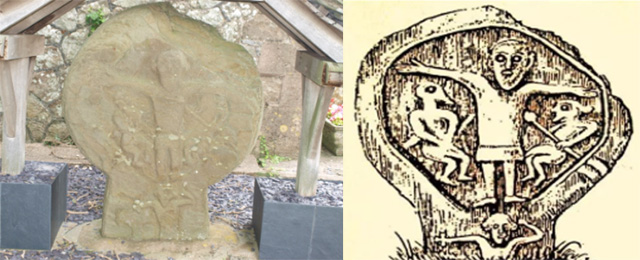
The Grade 1 listed Celtic wheel cross outside the west wall dates from the 9th Century. The pennant sandstone may be earlier, (the shaft typically 4-7m tall is now lost). Dedicated to St Canna, it was first documented by the Inspector of Ancient Monuments in 1888 it is set now in a shelter to prevent future erosion.
Celtic Crosses are attributed to St Patrick who adapted it to teach the gospel and holds deep significance in Irish and Scottish culture- a blend of pagan and Christian, the circle symbolizing the sun and the moon, eternal life, the rhythm of nature, experience, divinity. The halo around the cross representing Christ. The 1.3m high wheel cross differs in style to other wheel crosses in South Wales. It is a scripture cross which dates it to the 9th/10th century, depicting a disc head crucifixion scene with the figure of Christ on the Cross with Stephaton or Stephen the Roman soldier offering Jesus a sponge soaked in vinegar and the Roman soldier Longinus piercing his side with a lance. Legend was that he was partially blind but was healed when the blood and water splashed into his eyes leading to his conversion, “truly was the son of God “.
There are stylistic affinities with the Norse and Irish school of fissure sculpture notably the Cross of Muiredach in Monasterboice, composite Cross of the Scriptures in Clonmacnoise in Co. Offaly, the Maghera Lintel, the high cross of Ardboe, the 9thcentury cross in Armagh Cathedral, the unfinished Cross of Kells. There are numerous examples in Ireland and Gosforth Cross in Cumbria.
This image inspired by the Syrian Rabbula Gospels and St John’s Gospel (an eyewitness account) It is the only gospel to reference the spear of destiny.
The figure on the bottom represents Satan, the top of the Celtic Cross was heaven and the bottom the underworld. Christ tended to be beardless in early Irish crucifixion art wearing this columbium like garment.
The reverse side of the cross is plain Greek Cross. The sculptors based their designs on solid scriptural foundations from learned monks and their illuminated manuscripts notably the Book of Kells in Trinity College and predating this the 8th century Llandeilo Fawr (Teilo) Gospels in Litchfield Cathedral. Many were lost during the reformation.
Wandering missionaries and saints travelled the western seaways in coracles keeping Christianity alive in Ireland, Scotland, Cumbria, Wales and Brittany founding small monastic communities and teaching monasteries .St IIlltud in Llantwit Major established in the 5th century as a major centre of learning and craft workshops with missionaries sent to Ireland, Scotland, Cornwall and notably St Sampson in Brittany.
There is a collection of beautifully preserved Celtic Crosses on display in St Illtud’s Church and Galilee Chapel Llanwit Major.